Lumami, Nagaland, 09 November 2026: Researchers from Nagaland University, the only Central University in the State, have developed and tested a 50-item achievement test to measure how well teachers-in-training understand inclusive education.
This tool is designed to help identify gaps in teacher preparation and improve teaching practices for children with learning needs. The study is especially important in the context of the National Education Policy (NEP) 2020, which calls for teachers to be ready to build classrooms where all children regardless of ability can learn together.
There is a gap in how teacher education is assessed. Most tools today focus on teachers’ attitudes or confidence when dealing with classrooms. Few actually measure what future teachers know about education—its concepts, practices and policies. The new test aims to fill that gap. It can help teacher education institutions spot areas where trainee teachers struggle. For example if many students find it hard to understand policies for children with needs educators can adjust their teaching to include more information and real-life examples.
The findings were published in International Journal of Research and Innovation in Social Science (DOI: https://doi.org/10.47772/
Calling upon researchers to develop such solutions for real-world impact, Prof. Jagadish K Patnaik, Vice-Chancellor, Nagaland University, said, “I am pleased to note this significant research initiative by Nagaland University towards developing a pilot-tested tool to assess teachers’ knowledge of inclusive education. Inclusive education is fundamental to ensuring equitable, accessible and quality learning opportunities for every student, irrespective of their individual needs and backgrounds.”
Prof. Jagadish K Patnaik added, “The study addresses an important gap in teacher preparation by examining the understanding of prospective teachers and offers valuable scope for strengthening B.Ed. programmes, particularly in Nagaland and the North-Eastern region. I hope this research will contribute to improving teacher education, promoting inclusive classroom practices and advancing the vision of NEP 2020. I congratulate the researchers and all those associated with this meaningful academic endeavour. Nagaland University remains committed to promoting research that addresses societal needs and contributes to the advancement of education.”
The test was built around the B.Ed. Course-10 at Nagaland University titled ‘Creating an Inclusive School’. It covers five areas: special needs and education policies and provisions inclusive classroom practices building support networks and related concepts. The questions test levels of thinking—from simple recall to applying knowledge analyzing situations and evaluating possible solutions.
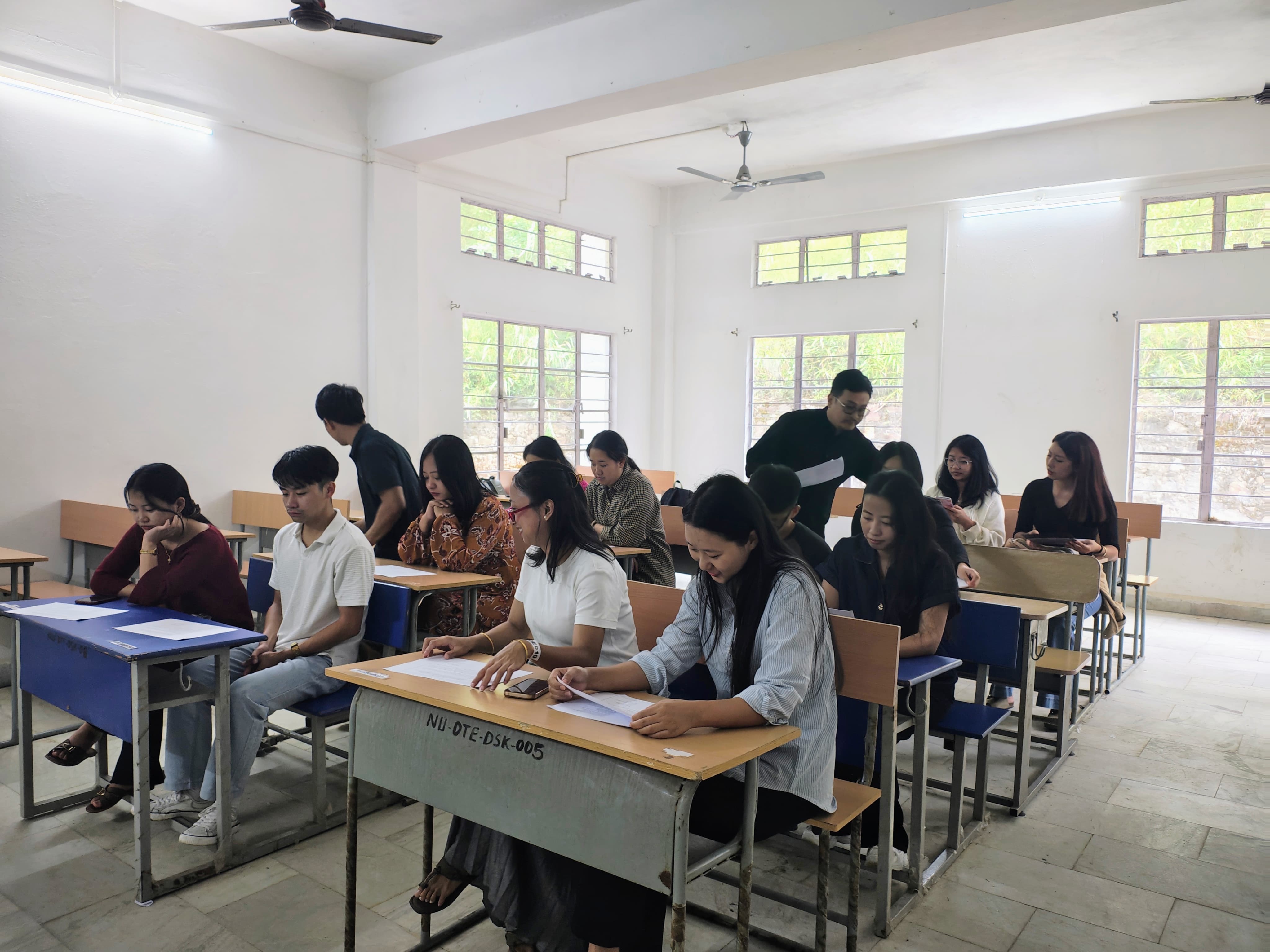
Elaborating on this research, Prof. Gyanendra Nath Tiwari, Department of Teacher Education, Nagaland University, said, “We started with 60 questions. We reviewed them before being used with 42 M.Ed. Students at the Kohima Campus. We looked at how difficult each question was, how well it could tell strong and weak performers and how consistent the test was overall.”
Mr. Aseto Iralu Meyase, Research Scholar, Department of Teacher Education, Nagaland University, added, “Based on our analysis we removed 10 questions that did not work well. This left us with a 50-item test. The internal consistency of the test, measured by Cronbach’s alpha went up from 0.641 to 0.727. This means the test is more reliable now. More testing is needed to confirm its stability across larger and more varied groups of trainee teachers.”
The results showed that questions asking students to apply or analyze knowledge performed better. That suggests it was more useful to test how well future teachers can use what they know not just what they remember.
‘INCLUSIVE CLASSROOMS’
Over time better teacher preparation could lead to more inclusive classrooms for children with different learning needs. The study doesn’t yet prove that higher test scores mean better teaching or better student outcomes. That needs research.
The work is especially important for Nagaland. Nagaland University is the institution in the state offering the M.Ed. Programme. So creating a tool that fits the context helps assess how well future teachers are being prepared for inclusive classrooms in the state.
The researchers stress that this is a pilot study. The test should be seen as an assessment tool, not a fully tested one. Next steps include testing it with trainee teachers across different colleges, in Nagaland. They want to see if the test works the way across different groups and whether scores match what teachers actually do in classrooms.
The method used could also be adapted to help North-Eastern States. Each state has its teacher education curriculum and context. This approach can guide the creation of tools that fit local needs.