New Delhi, Nov 21: India’s push to integrate artificial intelligence into public healthcare is gaining a multilingual dimension, with the government’s BHASHINI platform demonstrating how voice-based AI tools can help doctors document medical records faster and communicate with patients across language barriers.
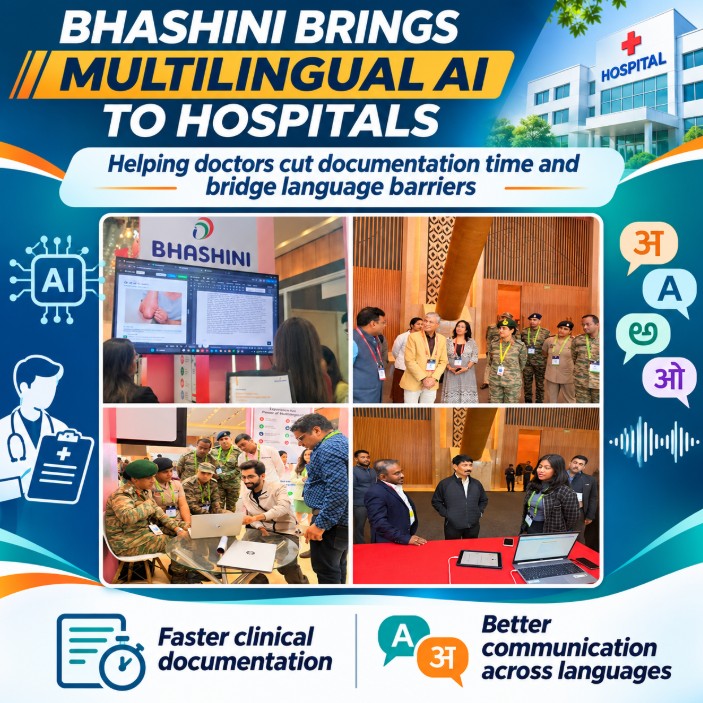
At the Global Digital Health Summit (GDHS) 2026 in New Delhi, BHASHINI showcased its language technology solutions alongside three major healthcare institutions — the All India Institute of Medical Sciences (AIIMS), Jawaharlal Institute of Postgraduate Medical Education and Research (JIPMER), and the Directorate General of Medical Services (DGMS), Indian Army.
The demonstrations focused on practical applications of speech recognition, text-to-speech and translation technologies in clinical settings, including recording patient histories, preparing prescriptions, documenting hospital rounds and communicating with patients in different languages.
The two-day summit, held at Bharat Mandapam on November 20 and 21, brought together government, healthcare, industry and academic stakeholders under the theme, “Implementing Artificial Intelligence – AI in Action”.
Voice-Based Medical Records at AIIMS and JIPMER
One of the key applications demonstrated at the summit was the integration of BHASHINI's speech technology into existing hospital information systems.
At AIIMS, New Delhi, the speech-to-text facility has been integrated with the National Informatics Centre's eHospital prescription module. The system allows doctors to dictate prescriptions instead of entering the information manually.
According to AIIMS, the technology received positive feedback during its pilot in the Neurology and Neurosurgery departments. The institute is now expanding the application across its facilities.
JIPMER has integrated e-BHASHINI with its e-Sushrut Hospital Management Information System. The system enables doctors to use voice inputs in English and supported Indian languages to document outpatient case histories, inpatient clinical notes and discharge instructions.
The integration is intended to reduce the time healthcare professionals spend on routine documentation, allowing them to focus more on patient care.
Army Medical Services Explore Multilingual Clinical Support
The Directorate General of Medical Services (Army) also presented its use of BHASHINI technology through the Dhanwantri platform.
The application converts doctors' spoken clinical notes into typed text, supporting voice-based medical documentation.
Maj Gen Sandeep Bhalla, ADGMS (IS, H and PS), said multilingual support was important for the Army's medical system because it serves personnel, retired servicemen and their families from different linguistic and cultural backgrounds.
He said the integration of speech-to-text technology could save doctors' time and make patients more comfortable by allowing them to communicate in languages they understand.
Shrutlekh Demonstrates Real-Time Transcription
BHASHINI also demonstrated Shrutlekh, its speech-to-text capability, during the summit sessions. The tool supports multilingual transcription and translation, illustrating how spoken communication can be converted into text across languages.
The exhibition featured the BHASHINI mobile application, which offers translation and voice-based services, along with Data Daan, an initiative encouraging community contributions of language data to strengthen Indian-language AI systems.
Another platform, Granthika, was presented for the guided collection and digitisation of written and oral language resources.
Building an AI Ecosystem for India's Linguistic Diversity
The Digital India BHASHINI Division operates under the Digital India Corporation and the Ministry of Electronics and Information Technology.
The platform supports 36 Indian text languages, 23 Indian voice languages and 35 international languages. Its services include translation, speech recognition, speech synthesis and transliteration.
According to the division, the BHASHINI ecosystem has processed more than 11 billion inferences, with around 24 million inferences being handled daily.
CEO Amitabh Nag said language should not become an obstacle to accessing essential services, particularly healthcare. He said collaborations with AIIMS, JIPMER and the Army's medical services demonstrate how multilingual AI can be integrated into everyday clinical workflows.
The demonstrations at GDHS 2026 highlighted the potential of indigenous language technologies to make digital healthcare more accessible and efficient. Their wider impact, however, will depend on how reliably these tools perform across languages and medical settings, and how effectively they are adopted by doctors and hospitals.
The broader objective is to ensure that linguistic diversity does not prevent patients from understanding medical advice or healthcare professionals from recording and accessing critical clinical information.