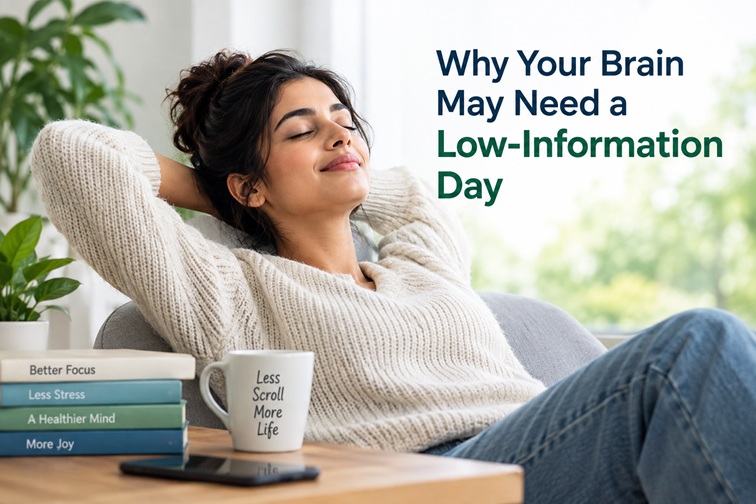
There is something strange about modern life: we can spend an entire day doing very little physically and still feel completely exhausted by evening. The reason may not always be work. Sometimes, it is simply the amount of information we have taken in.
A typical morning can begin with a WhatsApp message, a few Instagram reels, news headlines, emails and notifications before we have even finished our tea. During the day, there are meetings, conversations, videos, social media updates and messages. By night, many of us are still scrolling. Our bodies may be resting, but our brains rarely get a chance to be quiet. This is why the idea of a “low-information day” is worth considering.
We Are Consuming More Than We Realise
Most of us don't think of checking a notification as mental work. It takes only a few seconds. But then there is another notification. Another headline. Another reel. Another forwarded message.
None of these moments seems significant on its own. Together, they create a continuous stream of information that our attention has to deal with.
For an office worker in Bengaluru, a student in Delhi or someone managing a household in Kerala, the sources may be different, but the experience can be similar: there is always something new asking to be noticed.
This constant input can contribute to information overload, where the amount of information coming in becomes difficult to process effectively. The brain has limited attention and working memory, so constantly taking in new material can leave less mental space for concentrating on what actually matters.
Mental Exhaustion Can Come From Constant Switching
Sometimes we blame tiredness on having too much work. But mental fatigue can also come from constantly moving between unrelated things.
You may be answering an email when a phone notification appears. You check it, see a social media update and then remember a message you have not replied to. Later, you open a news app and end up reading several unrelated stories.
By the end of the day, it can feel surprisingly difficult to concentrate on one thing. This is partly because attention does not always move cleanly from one task to another. Even after we switch away from something, part of our attention can remain attached to what we were just doing. This idea, often discussed as attentional residue, helps explain why a day filled with small interruptions can feel more tiring than expected.
The problem isn't necessarily that we are learning too much. It is that we are rarely giving our attention a chance to settle.
A Low-Information Day Is Not a Digital Detox
The two ideas may sound similar, but they are not quite the same. A digital detox usually focuses on reducing or avoiding digital devices. A low-information day is broader. It is about reducing unnecessary mental input, whether it comes through a phone, television, social media, news websites or even endless online conversations.
Life doesn't allow most of us to disappear from technology completely. We need our phones for work, family, banking, travel, education and emergencies. A low-information day simply means being more selective about what gets our attention.
There is a difference between checking something because we genuinely need to know it and checking something because we are used to checking. That small difference can matter.
Your Brain Needs Empty Space Too
We often treat every quiet moment as an opportunity to consume something.
Waiting at a clinic? Open the phone.
Sitting in the car? Watch a video.
Having coffee? Scroll through social media.
Standing in a queue? Check messages.
Eventually, even a few minutes of doing nothing can feel uncomfortable.
But quiet moments have value. When there is no constant stream of new information arriving, thoughts that have been pushed aside during a busy day can have more room to surface.
That may be why ideas sometimes appear while taking a shower, travelling, walking or staring out of a window. We were not necessarily trying to solve a problem. We simply stopped filling every available moment.
Not Every Headline Needs Our Emotional Attention
There is another side to information overload that is easy to overlook. A lot of what we consume is emotionally charged.
News about accidents, conflicts, arguments, financial uncertainty or celebrity controversies can affect our mood even when none of it directly involves us. Social media adds another layer because we don't just see an event; we see hundreds of reactions, opinions and arguments surrounding it.
Being informed is important. Being emotionally pulled into every update is something else. Choosing not to consume every headline immediately does not mean being careless about the world. It can simply mean recognising that attention and emotional energy are limited resources.
Less Input Can Make Ordinary Life Feel More Interesting
When our attention is constantly occupied by screens, ordinary experiences can become background noise. A cup of tea on the balcony. A conversation with a parent. Children playing nearby. The smell of rain. An evening walk.
These things may not compete very well with a colourful reel or a breaking-news notification. But they offer something the internet cannot always provide: presence. When there is less information competing for attention, we may start noticing what is actually around us.
This can be particularly valuable in a culture where family interactions, shared meals and everyday social connections remain an important part of life. Sometimes being mentally present with the people around us is more restorative than consuming another piece of content.
Young Minds Need Quiet Too
For young people, the issue can be even more complicated. Students are expected to learn from online resources, stay connected with friends, follow trends and increasingly build a digital presence. Information can be useful and empowering, but constant exposure can make it difficult to recognise when the mind needs a break.
The answer is not to keep young people away from technology. Online learning, communication and digital skills are now part of everyday life. What matters is developing the ability to decide what deserves attention and what can simply be left for later. That is a valuable form of digital wellbeing.
The Goal Is Not to Know Less
A low-information day is not an argument against technology, news or social media. It is a reminder that attention is limited.
We cannot absorb everything, react to everything and stay mentally fresh at the same time. Perhaps a healthier relationship with information is not to consume as much as possible, but to become comfortable with leaving some things unread, some notifications unanswered and some updates unknown.
The world will continue producing information whether we consume all of it or not. We live in a world that rarely stops talking. Our brains may occasionally need us to stop listening. And sometimes, a little less information is exactly what gives us the space to think, notice, breathe and return to our own lives.