
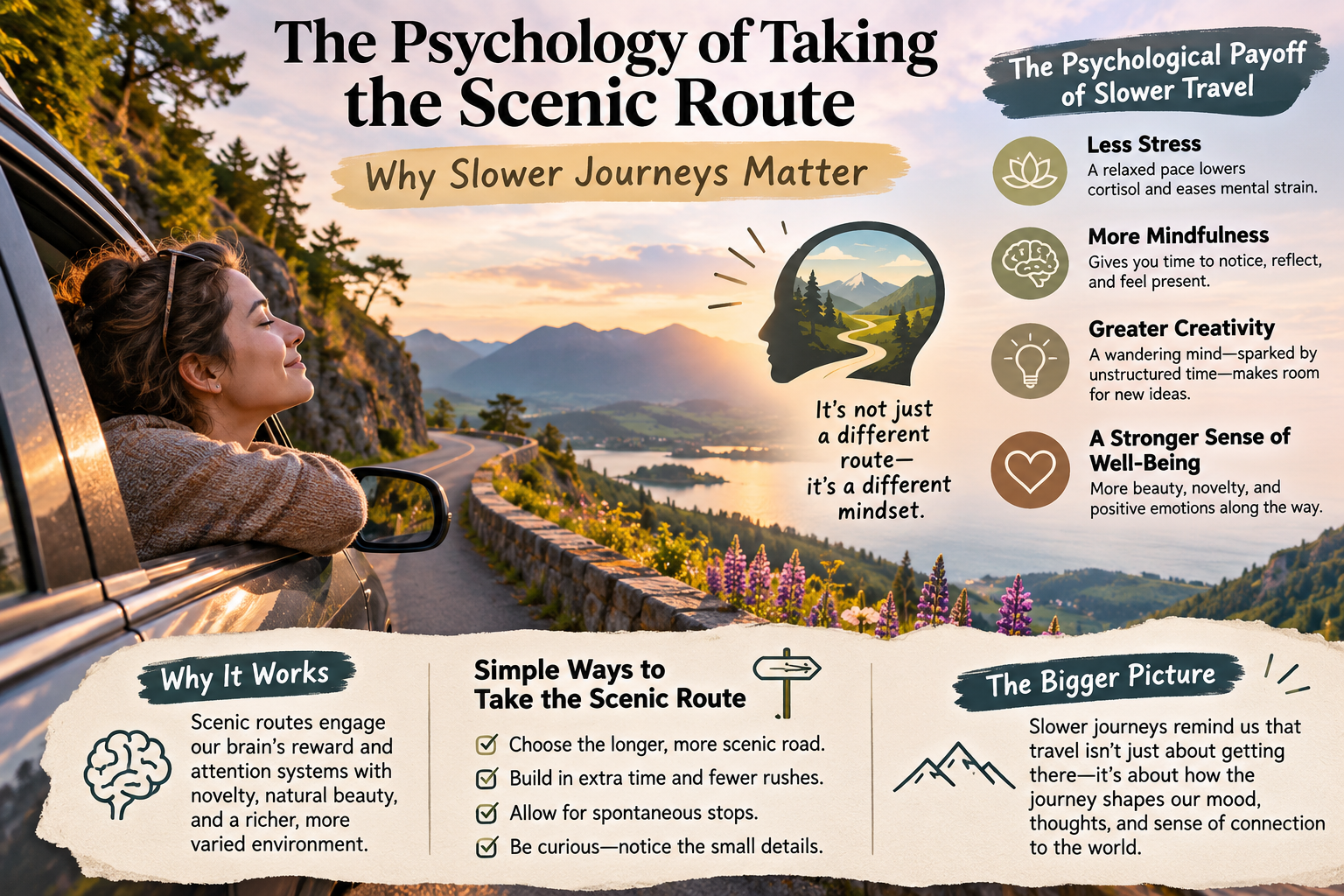
Nov 19: Imagine travelling somewhere with a little time to spare. Instead of taking the usual highway, you choose a road that passes through green fields, quiet villages or a stretch of coastline. You notice a small tea shop, a row of trees or a view that makes you want to stop for a moment. The journey takes longer, but somehow, it feels more enjoyable.
Most of us are used to choosing the fastest route. We check navigation apps, compare travel times and look for ways to avoid delays. Reaching our destination as quickly as possible often becomes the main goal. But in our hurry to get somewhere, we sometimes miss the little things that make a journey worth remembering.
Taking the scenic route is not simply about finding a beautiful road. It is also about giving ourselves the chance to experience our surroundings differently. There is an interesting psychological reason why a slower journey can sometimes feel more rewarding than a quicker one.
Why Are We Always in a Hurry to Reach Somewhere?
Modern life has made speed feel like a necessity. We expect quick deliveries, instant replies and faster ways of getting things done. This mindset has gradually entered the way we travel, too. We plan journeys around how quickly we can arrive, often treating every extra minute as wasted time.
Even during holidays, we can fall into the same habit. We make lists of places to visit, plan tight schedules and try to fit as much as possible into a short trip. By the end, we may have visited several attractions but barely had time to enjoy any of them.
There is nothing wrong with wanting to save time. Sometimes, reaching a destination quickly is important. But efficiency and enjoyment are not the same thing. A journey does not become meaningful simply because it is completed faster.
Why Familiar Roads Make Us Stop Paying Attention
Think about the road you take to work or college every day. You probably know where to turn, which junction gets crowded and where traffic usually slows down. After travelling the same route repeatedly, you no longer need to pay close attention to every detail. Much of the journey happens almost automatically.
Psychologists often describe this as habituation. When we are repeatedly exposed to the same surroundings, our attention to them tends to decrease. We may pass the same shop, tree or building every day without really noticing it.
A different route changes that experience. Unfamiliar surroundings encourage the brain to become more alert. We begin noticing buildings, roadside shops, landscapes and small details that would normally go unnoticed. Even an ordinary place can feel interesting when we see it with fresh eyes.
This is one reason a scenic route can feel refreshing. It interrupts the automatic routine and gives our attention something new to explore.
How Natural Surroundings Can Refresh the Mind
A quiet road lined with trees, an open stretch of countryside or a coastal drive can feel very different from a crowded, noisy highway. When the surroundings are pleasant and the journey is not stressful, we may find ourselves feeling more relaxed.
There is a psychological concept known as attention restoration theory. It suggests that natural environments can help restore our capacity for directed attention, the kind of concentration we use when working, studying or dealing with everyday responsibilities. Unlike tasks that demand constant focus, natural surroundings often hold our attention gently, without requiring much effort.
This does not mean that every scenic journey will make us feel peaceful. A longer drive through bad roads or heavy traffic can be tiring. The experience depends on the conditions, our expectations and whether we actually have time to enjoy the journey.
Still, there is something valuable about travelling without constantly checking how many minutes remain. When we are not completely focused on reaching the destination, we may become more aware of how we feel along the way.
The Unexpected Joy of Discovering Something New
Some of the most memorable travel experiences are not always part of the original plan. It could be a small restaurant serving a local dish, a quiet riverside spot or a village market that catches our attention.
Imagine taking a different road during a weekend drive and coming across a little shop selling freshly prepared local snacks. You stop for a few minutes, try something unfamiliar and perhaps exchange a few words with the shopkeeper. It may not become the highlight of a major holiday, but it can turn an ordinary afternoon into a pleasant memory.
These discoveries are easy to miss when every minute of a trip has been planned. A tight schedule leaves little room for curiosity. Of course, travelling without any plan is not practical for everyone. Safety, time, road conditions and other responsibilities matter. But leaving a little breathing space in an itinerary can make a difference.
Sometimes, the most interesting part of a journey is something we never intended to find.
A Different Way of Looking at Time
We often measure a journey by how much time it takes. A route that saves twenty minutes is considered better than one that takes forty minutes longer. But time is not valuable only when it is saved. It can also be valuable when it is enjoyed.
Consider two journeys. One takes you straight to your destination, with little opportunity to stop or look around. The other includes a cup of tea at a roadside shop, a short walk or a pleasant view along the way. The second journey may take longer, but it may also leave you with more to remember.
This is not an argument against efficiency. It is a reminder that the fastest option is not automatically the most satisfying one. Sometimes, the way we spend our time matters more than how quickly we complete something.
Bringing the Scenic Route Into Everyday Life
We do not need to plan a holiday or travel to another city to experience this change. It can begin with small decisions. Take a different road on a weekend, walk through a street you have never explored or visit a nearby place without filling the day with too many plans.
Even familiar surroundings can offer something new when we give them our attention. A tree that has stood beside the road for years, a little shop we have never entered or a quiet corner in our neighbourhood may suddenly become more noticeable.
The idea is not to turn every ordinary journey into an adventure. It is to avoid moving through life so automatically that we stop noticing where we are.
Sometimes, the Journey Deserves as Much Attention as the Destination
There will always be days when we need to reach somewhere quickly. Deadlines, responsibilities and practical concerns cannot simply be ignored. But when time allows, choosing a slower route can offer a welcome change.
A roadside cup of tea, an unexpected conversation, a beautiful stretch of road or a few quiet minutes looking at the scenery may become the part of the day we remember most.
Perhaps the value of taking the scenic route lies in something simple: it reminds us that we do not have to rush through every experience just because we can. We spend so much time planning where we want to go that we sometimes forget to notice where we are. And occasionally, the most rewarding part of getting somewhere is discovering that there was something worth experiencing all along the way.